
 Women over 50 in particular need to get started with strength training if they want to remain independent later in life.
While men are also vulnerable to sarcopenia, the age-related loss of muscle mass, women tend to be more prone to osteopenia, or loss of bone density.
The combination of both sarcopenia and osteopenia can have devastating consequences.
Strength training is one way to help avoid both of these issues before they get started, or to potential reverse their effects.
Yet very few women over 50 tend to engage in legitimate strength training.
Those who are at least fitness conscious tend to gravitate toward exercise such as yoga, Pilates, or even rumba classes.
Don’t get me wrong. Any exercise is great but none of these activities will have a more positive impact on a woman’s health than legitimate strength training.
Strength training for women over 50
What do I mean by “legitimate strength training?”
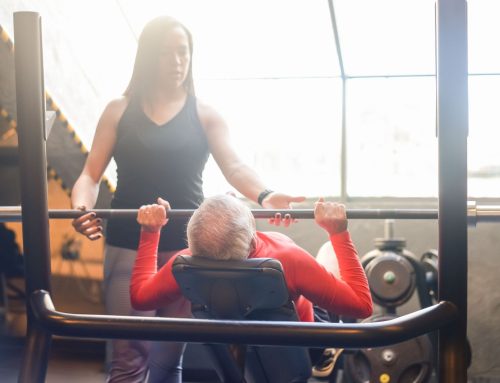
I am referring to training with barbells with the four main lifts… the squat, deadlift, bench press and overhead press.
Right about now if you are a woman over 50 reading this, you are probably ready to exit this page… STOP!
Stay right here and hear me out.
Most of you want to stay thin, and I get that.
But thin as you get older means weak.
You need to forget about maintaining a particular figure and focus on getting STRONG!
And for the love of God, do not get caught up in the GLP1 craze if you are already at or modestly above a healthy weight.
You do not want to go down the same road as Demi Moore.
Rant over.
Back to the barbells.
A great place to start training with barbells is the Starting Strength method.
With that method, you train the squat, deadlift, bench press and overhead press.

72 years old
Except for the deadlift, you will typically perform three working sets of five reps for each exercise, after several warm-up sets.
With the deadlift, only one set of five reps is sufficient for our purposes.
There are generally two workouts, which you alternate.
Workout A = Squat, bench press, deadlift
Workout B = Squat, overhead press, deadlift
These workouts are alternated and you train Monday, Wednesday and Friday or a similar schedule, with a rest day in between the workouts.
After a month, we add lat pulldowns to the program, and begin to alternate them with the deadlift, so that the workouts look like this…
Workout A = Squat, bench press, deadlift
Workout B = Squat, bench press, lat pulldowns
With the lat pulldown you would do three sets of ten reps.
With each exercise, you start at a conservative weight. You don’t start at a weight where you can barely do five reps.
You determine the starting weights with your first workout.
For instance with the bench press, you may only be able to start with a couple of 5 pound dumbbells, but for this example, we’ll start with an empty standard barbell (1 inch around), with a 5 pound plate on either side. That’s about 29 or 30 pounds.
You start at this weight because in your first workout you found that at a weight of 40 pounds, the fifth rep was difficult to complete.
So you back off from that weight, start at about 30 pounds, and then do 3 sets of 5 reps.
Then, the next workout, you add a couple pounds, and again do 3 sets of 5 reps.
This is known as progressive overload.
You continue with this process until you fail to get the 5th rep for two or three of the sets.
And then it is time to adjust your programming.
Women can train a little differently than men
Strength training for women over 50 will warrant some minor modifications to their training compared to men of the same age.
Women have less overall strength and muscle mass, and much less upper body strength compared to lower body strength.
Yes there are some women out there who are stronger than most men. But they are obvious exceptions, and we are talking in generalities here.
With that said, women tend to be able to perform multiple repetitions at a higher percentage of their one rep maximum weight than men.
Also, women have a greater ability to recover from workouts and therefore can train with greater frequency and training volume.
Starting out, women will train as indicated above, with three sets of five reps.
After a period of time, they will benefit more by doing sets of one to three reps at a heavy weight.
Furthermore, they’ll be able to train the deadlift more often than men.
The myth of bulking up

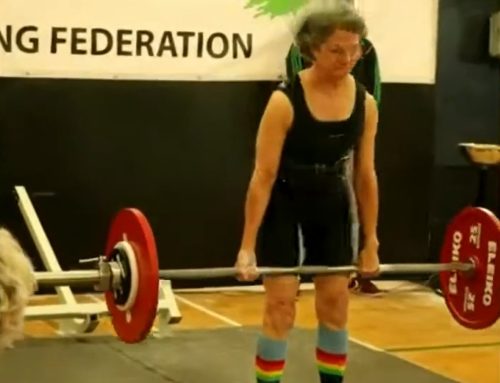
Strong at 66!
Remember, as a woman, you are starting out with less muscle mass than a man to begin with, particularly in the upper body.
Also, if you are reading this, you are likely over 50 years old.
Therefore, it will be more difficult for you to put on as much muscle as a man in the same age group.
There are a few reasons for this.
First, women in general have less neuromuscular efficiency.
Second, women have much lower resting and after-exercise levels of testosterone than men.
And lastly, women have smaller type II muscle fibers, which are related to power production, relative to their Type I fibers, which are related to endurance.
With all this in mind, it will require a much greater period of time for a woman to achieve the same level of strength of a man if both start out at an equal age and weight.
As a result, it will take far longer for a woman to lift enough weight to result in a substantial increase in muscle mass.
And this is exactly why women over 50 need to get started with strength training sooner rather than later.
If you are looking for inspiration, watch this video of the lady in the “Strong at 66” photo above.
Final thoughts
Remember the ultimate goal is to stay out of the senior living facility as long as possible and maintain your independence.
The main reason people over 75 find themselves in those facilities is the loss of mobility due to frailty caused by sarcopenia and/or osteopenia.
Legitimate strength training is the best path to avoid that future and to continue to live a high quality of life even in your advanced years.
As indicated, strength training for women over 50 is really not much different than it is for men.
You train the same exercises and in general, the same rep range.
However, because women in general have less overall strength and muscle, they have to work a bit harder to get stronger.
Please consider signing up for our newsletter to get more training tips!