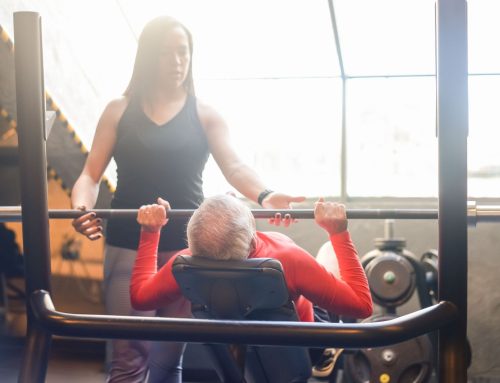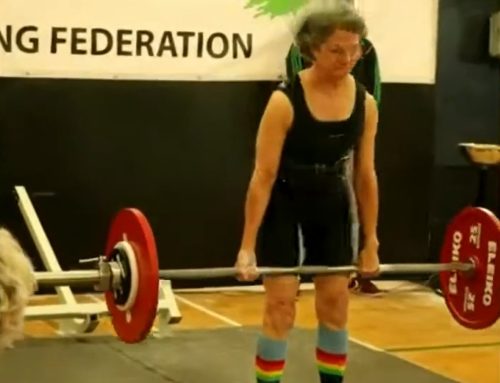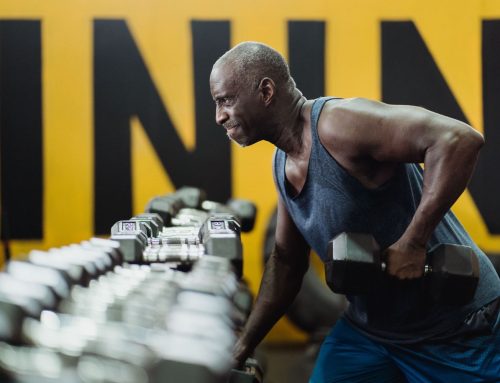

Strength training is the cornerstone of fitness and health for the Champion of Aging. There is no other form of exercise that will benefit you more if you are lucky enough to live to an advanced age.
While everyone knows that lifting weights helps you build strength and muscle, few people outside of trainers, physical therapists and medical professionals, understand the physiological processes involved.
Furthermore, strength training can have a positive benefit on bone density and overall cardiovascular health for trainees who are new to exercise.
As I am a believer that knowledge is power, I thought I’d provide a more in depth view how the body adapts to strength training.
The bulk of this presentation is from a course I took through Barbell Logic and it is required knowledge for potential strength coaches. I recommend you check them out.
Let’s get to it.
How the body actually builds muscle
Certain internal and external signals can influence the process of muscle synthesis, causing the body to actually build new muscle tissue.
Here are some key takeaways regarding muscle protein synthesis (MPS).
MPS upregulation starts very shortly after a strength training session and continues for at least 12 hours.
There are a number of different signals that appear to trigger MPS independently. The most important appears to be mechanotransduction, aka, the tension in the muscle cell as it contracts.
Other signals that appear to upregulate MPS include:
- Muscle damage
- Hormonal signals
- Dietary Intake, protein in particular
Each individual training session generates a small signal, but repeated signals of significant magnitude accrue over time to significant net muscle growth.
How muscle fibers get bigger
At the level of the muscle fiber, there are two possible ways to increase muscle size:
Hyperplasia: the addition of new muscle fibers within a muscle
Hypertrophy: an increase in the size of current fibers.
Animal research shows hyperplasia is possible, but research on humans, has been mixed.
It is clear that the myofibers within the muscle fiber grow in size—and in number—by adding new material (a process called myofibrillar hypertrophy), which enlarges the muscle fiber.
Hypertrophy generally becomes measurable within the first few weeks of training.
It is unclear at the level of the muscle fiber whether hyperplasia is possible. If it is, it likely occurs after cells have grown past a particular threshold in size and doesn’t become measurable until a trainee has already grown in size.
Besides myofibrillar hypertrophy, muscles also grow by adding non-contractile proteins. This is known as sarcoplasmic hypertrophy.
Both types of hypertrophy happen with training.
Even when myofibrillar density increases (the percentage of a muscle made up of contractile tissue), we still see an increase in the proteins of the myoplasm, and this is a positive adaptation.
These proteins play functional roles in metabolism and enable the lifter to handle greater training volumes.
Also, different fiber types have different force production properties.
- Type I fibers are smaller, more effective at aerobic energy production, and more enduring,
- Type II fibers are larger, more effective at glycolytic energy production, and fatigue quickly.
None of the skeletal muscles we consider in strength training are 100% type I or type II.
The ratio between these fibers contributes to how powerful—and how fatigable—a muscle will be for a lifter in a given exercise, and all muscle fiber types are trainable.
Muscle fibers do adapt within their fiber types.
Both type I and type II fibers will get larger with training, but type II fibers are more responsive and grow bigger.
Bone adaptations to strength training
In regard to research regarding exercise and bone adaptation, here are a few takeaways…
General activity is useful and may help maintain bone, but a person needs a greater load or impact to grow stronger (denser) bone and resist osteoporosis.
Running and walking may be insufficient stimuli for bone growth.
For ideal bone health, lifters should lift relatively heavy and play high-impact sports while they are able.
As they grow older, lifters should maintain activity and heavy strength training within their personal risk profile. Tackle football at 60 might not be an option for everyone.
Like the wood of a tree, bone is alive and dynamic, replacing the old surface bone with new cells approximately every four months.
There are two types of cells within the bone that do this work… Osteoclasts and Osteoblasts.
Osteoclasts break down old bone tissue, releasing their mineral content into the extracellular space.
Osteoblasts pull mineral content from the blood, lays down new infrastructure, and facilitates ossification—the hardening of new bone tissue.
Hormonal and mechanical signals regulate these two processes to ensure that bones stay structurally sound and dense enough to handle necessary stresses without becoming unproductively large and heavy.
When signals triggering resorption (the breakdown by the osteoclasts) are greater than those triggering osteogenesis, the bone loses density, leading to osteopenia (low bone mass) and osteoporosis.
Many studies have been done on the effects different forms of training have on bone, though their results are mixed and are best understood in context:
Bones respond to heavy load, not repetitive stress
The micro-fractures caused by miles of distance running aren’t reinforced but replaced, leaving the bone approximately the same size or a tiny bit larger.
Heavy loads and high impacts, however, signal new bone to grow.
When athletes are compared across sports, weightlifters, wrestlers, and gymnasts consistently have higher BMD (bone mineral density) than long-distance runners, triathletes, swimmers, and divers.
Sedentary lifestyles kill bones
Lack of use, whether from medical bed rest or a sedentary lifestyle, leads to a slow decrease in BMD over time.
The effect is worse for older people and post-menopausal women.
Bone grows slowly
Because of the long remodeling period, studies under four months are unlikely to see results.
One study found that the gains of BMD from a moderate resistance training program in adult women were too small to be clinically relevant, but the training duration was only eight weeks.
Bone growth is specific
Professional soccer players have much higher total bone mineral content (BMC) in their legs and hips than their age-matched controls (25 and 35 percent more, respectively), but they have only a little more in their trunk and arms (14 and 10 percent, respectively) and no difference in their skulls.
Bone breaks down slowly
Highly competitive young weightlifters have BMC scores well above their peers, and some of that advantage is retained as they get older.
Malmo University in Sweden found that men who had been retired from the sport of weightlifting for 30 years still had above-average bone mass until age 65.
The best part of that study, though, was that those who continued to exercise more than their peers (not weightlifting, but other activities) did a better job of keeping their bone mass advantage into old age.
Connective Tissue Adaptations
Connective tissue includes tendons, ligaments and cartilage. Here are some key takeaways from research regarding training adaptations and connective tissue.
- Tendons grow by adapting to specific stimuli more than getting bigger.
- Ligaments don’t adapt much since they aren’t stressed near their limit during correctly executed movement.
- Strength training can support connective tissues in their work and reduce the loads and situations where a ligament may exceed its limit by strengthening the muscles around the ligaments, which keep the bones in their correct position.
- Cartilage doesn’t adapt much (if at all) to training but being sedentary causes long-term degradation.
- For strong connective tissue, spend time in strength sessions at a 70% 1 rep maximum load or greater in each major movement pattern. Train consistently for long periods to keep tendons strong and keep general activity up to preserve cartilage.
Connective tissue physiology
Although connective tissues involve a wide variety of cells within the body, we’re keeping this discussion to tendons, ligaments, and cartilage.
Tendons/Ligaments: Like muscles, tendons and ligaments are fibrous, consisting of bundles of parallel fibers oriented in a direction and bound by extracellular wrappings, which give them shape and hold them together.
Tendons transfer the force from muscles to bones the way a tow cable transfers the force from a truck to the trailer it pulls.
Ligaments attach bone to bone and generally provide passive resistance to movement.
Tendons and ligaments allow a certain amount of stretch. Too much stretch would allow bones to travel too far from each other. Too little stretch would limit normal motion and increase the chance of tearing. This resistance to change is called stiffness.
Cartilage: There are many types of cartilage in the body, but the most relevant for our purposes is articular cartilage: a smooth, lubricated, elastic tissue that fits between freely movable joints like shoulders, elbows, hips, and knees, reducing friction.
Cartilage is avascular, meaning it is not directly fed by blood vessels and instead relies on nutrients from the surrounding tissue to diffuse through the cartilage slowly.
Additionally, the chondrocytes that create new cartilage—unlike in bone—are bound in lacunae: fixed structures that make up the frame of the tissue and are not able to freely move to injured areas.
Tendon/Ligament Adaptations:
Tendons/Ligaments: Tendons primarily respond to resistance exercise by changing their structural properties—their stiffness, orientation, and the protein makeup of their matrix.
Although some reports show an increase in size after significant training, this hypertrophy is small and is rarely observed in older lifters.
Still, tendon strength increases along its axis of strain as a result of training because their matrix orients to optimize strength in that direction.
Tendon adaptations appear to depend on higher intensity efforts (greater than 70% of maximum) and improve with repeated stimulus over time.
Maximizing tendon adaptations involves training at or above 70% of maximum intensity for sustained periods of time (months and years, not weeks).
Ligaments are not intentionally targeted in resistance training, so most research focuses on the breaking load of ligaments.
Cartilage: Being avascular, cartilage does not appear to adapt much (if at all) to resistance training. Cartilage size is highly genetic, and it does not increase in size with training.
There is some suggestion that there are cellular-material changes that improve its qualities from strength training but there is minimal evidence to that effect.
Nervous System Adaptation
In relation to strength training, nervous system adaptations include a variety of changes in the brain, the neuromuscular junction, the muscle fiber, and surrounding tissues that potentially increase how much force the brain can generate with the same muscle.
Neural adaptations are rapid. There is a noticeable impact on strength output within the first few sessions of training (and some even within the first session).
Neural adaptations also play a significant role in determining the effectiveness of the available cross-sectional area of muscle.
One study found that after 100 days of isometric training, maximum strength doubled while CSA (cross-sectional area, the thickness of a slice of muscle) increased only 23%.
The strength-per-CSA ratio increased by 50%—suggesting the lifter got more force out of the muscle than they had previously. Unfortunately, the exact details of how this happens are not entirely clear and it is beyond the scope of this post to go into the possibilities.
Ultimately…
- Nervous system adaptations happen quickly but slow down soon thereafter, yet they still continue throughout a lifter’s training career.
- The brain has to play a complex dance to balance out the many considerations that go into strength.
Cardiovascular Adaptation
For people who have never trained before, whether it involves lifting weights or cardio specific exercise, they will get positive cardiovascular health benefit from strength training.
Strength training alone will not be sufficient for aerobic training, but there is aerobic benefit derived when going through a well executed novice lifting program.
Overall, strength training is safe for the heart with few exceptions.
Basic Cardiovascular Physiology
The heart is traditionally seen as the domain of the endurance athlete, but resistance training has an effect on the heart—as it does with virtually every bodily system.
Structural Changes: The heart traditionally goes through two key changes as the result of exercise: an increase in left ventricular cavity size (how much room there is in the chamber to force more blood out with each pump) and thickening of the left ventricular wall to handle the additional force the heart has to produce to continue pumping while the peripheral muscles squeeze down on the arteries and veins.
Strength training has a small positive effect on left ventricular cavity size and a significant effect on wall thickness. These adaptations are collectively called “athlete’s heart.”
An occasional criticism of strength training is that the increased wall thickness predisposes a lifter to hypertrophic cardiomyopathy (HCM), a condition where increased wall thickness threatens the heart and can lead to sudden death.
Athlete’s heart is qualitatively different, as HCM happens because of a defective protein (not training) and causes growth much larger than anything an athlete can achieve.
VO2 Max: VO2 Max is the body’s total ability to use oxygen for energy—often called “maximal aerobic power.”
Those with a low VO2 Max appear to see some benefit from resistance training, but not those who are already fit and healthy.
The strength training that contributes most to VO2 Max improvements seems to be high-intensity training to failure or near-failure, and the adaptations appear to be at the muscle level, not at the heart.
General Cardiovascular Health: Some studies have shown that bodybuilders and other strength athletes have better lipid profiles than untrained people but more research is needed.
Final Thoughts
Most people won’t get through reading this entire article in one sitting, so bookmark it and come back to it later.
In the final analysis, there is plenty of research to suggest that strength training is likely the most beneficial form of exercise you can do overall.
This is particularly the case with people 50 and over.
Unfortunately, not enough people in this age group and over engage in legitimate strength training.
This is why the senior living communities are filled with people who are too frail to remain independent in their advanced years.
With this in mind, it only makes sense to incorporate strength training into your fitness program.
Therefore, I highly encourage you to sign up for our Champion of Aging Tactics newsletter to gain more understanding.