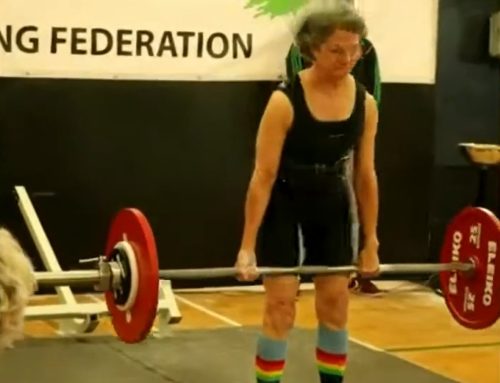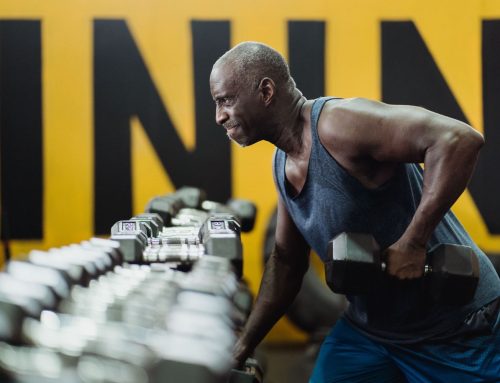

If you are over 50 and you want to be sure to stay out of the senior living center if you live to 80 and beyond, you need to build muscle.
What I am going to provide you with is a blueprint to build significant muscle and strength over the next twelve months, and how to maintain that muscle mass for as long as possible.
The best exercises for building strength and muscle
First, we must identify the best exercises for building strength and muscle.
 These exercises are the squat, deadlift, bench press and overhead press.
The reason why these are the best exercises is that they are based on natural human movement patterns, they involve multiple joints and muscle groups, and as a result, they can be loaded with the most weight over time.
The squat and deadlift in particular train a ton of muscle mass, so it only makes sense to incorporate them into your program.
Some other excellent exercises include pullups and chin ups, lat pulldowns, bent over rows, incline bench press and Bulgarian split squats.
In order to perform these exercises, you will need access to appropriate equipment.
The initial strategy for building strength and muscle
The best initial strategy for building strength and muscle is to train the entire body three days per week with the four exercises mentioned.
First, you must determine your starting weights for these exercises.
You then embark on a strategy whereby you train three days per week with a day of rest in between along with a weekend of rest.
There are two basic workouts.
Workout A includes the squat, bench press and deadlift.
Workout B includes the squat, overhead press and deadlift.
These workouts are then alternated so that you train each of them three times every two weeks.
For the squat, bench press and overhead press you will perform three working sets of five reps.
For the deadlift you will perform one working set of five reps.
Prior to the working sets you perform several warm-sets starting with a very light weight and then working up toward your working set weight.
With each workout, you will add some weight to the bar for each exercise.
So, if you start out on day 1 with 100 pounds for three sets of five reps, for the next workout, you may add five pounds so that the weight is 105 pounds.
After about a month, we typically like to begin alternating the deadlift with another pulling exercise such as chin ups or lat pulldowns.
You will then do your deadlifts every other workout.
Eventually, the weight on the bar for each exercise, usually starting with the overhead press, gets too heavy to continue to add weight and still perform three sets of five reps.
This is when new programming comes into play, which I won’t get into here.
This general program is referred to as the Novice Linear Progression (NLP) as the new lifter is able to display new levels of strength from one workout to the next.
Eventually this lifter has added so much weight to the bar that it becomes impossible to display new strength each workout, and the goal then becomes from week to week, then month to month and so on.
The NLP typically lasts from four to six months.
Over that time frame, you will have gained a considerable amount of muscle, assuming you’ve eaten well.
However, now you can incorporate other training ideas to focus more attention on building muscle.
This becomes easier because bodybuilding programs typically involve more sets and reps, but at lighter weights, and now the weight that feels light to you is much heavier than it was prior to embarking on the NLP.
Bodybuilding tactics
There are far too many bodybuilding tactics and strategies to discuss in detail here.
However, there are some basic tactics that you may want to incorporate into your training.
Pyramid training
 Pyramid training is a popular method for building muscle. It involves starting with a lower weight with higher reps, and then adding weight each set, while decreasing the number of reps.
A pyramid set may look something like this…
Set 1 – 12 reps at 150 pounds
Set 2 – 10 reps at 160 pounds
Set 3 – 8 reps at 170 pounds
Set 4 – 6 reps at 180 pounds
Typically, there will be limited rest between sets so that the muscle gets more and more pumped as you move up the pyramid.
A common approach for bodybuilders is to start with as many as 20 reps, and then pyramid with 15, 12, 10 and 8 reps for the last set.
Supersets
A superset involves training two exercises back-to-back. This is typically done by performing two exercises that are training different, but related muscle groups.
For instance, if you are trying to build significant size in your arms, you may combine a barbell curl with a triceps pressdown.
Another superset may involve leg extensions and leg curls.
Still another superset may target the same muscle group in an effort to pump as much blood into that muscle group as possible.
One that I often train with is a bench press followed by dumbbell chest flies.
Supersets typically involve training with higher reps. When both sets are complete, you will rest about 90 seconds to two minutes, and then perform another set.
You can also do supersets in a pyramid fashion as described on the previous page.
When a body builder is preparing for a competition, more supersets are employed.
This has the effect of helping them burn more calories during a training session, which helps them lower their body fat to the desired level.
Slow reps
Another technique body builders will employ are slow reps. The idea here is that more muscle fibers will get involved in the exercise, and thus more blood will be pumped into the muscle.
A typical exercise often involves two counts during the eccentric phase of a lift and one count on the concentric phase.
For example, in the bench press, you lower the bar to your chest on a count of two, and then push it back up on a count of one (assuming the weight isn’t too heavy!).
The slow rep technique may involving lowering the bar on a count of eight and then pushing the bar back up on a count of eight.
This requires use of light weight, otherwise you won’t be able to perform very many reps.
These next three methods were employed by Arnold Schwarzenegger during his competition days when he was attempting to build mass.
1-10 Method
After a warm-up set or two, find a weight you’re only able to get 1 rep.
After you perform that 1 rep, take just enough weight off to perform 2 reps.
From there, do the same for 3 reps and 4 reps, going all the way up to 10 reps.
This is brutal because you take no rest in between sets. The only rest you get is when you’re unloading the weights. This was a very effective way to vary things, and it’s a total shocker to the muscle.
Shocking Principle
Immediately after your final work set, take some weight off and get 5-10 reps.
Then with no rest keep repeating, reducing your weight until you’re down to the empty bar, repping that for 20 reps, or to failure.
Max Effort
Pick 1 exercise and see what you can do for a 1-rep max. To get there, work up to the weight with the following rep pyramid, taking ample rest between each set: 20, 15, 10, 8, 5, 3, 1, 1, 1 (max).
Multiple exercise approach
Body builders are effectively working as a sculptor of their own body. Therefore, they will employ multiple exercises to target a single muscle group to shape it perfectly.
For instance, a common approach to training the shoulders is to employ the following exercises…
Seated Dumbbell Press – This hits most of the shoulder muscles
Upright Row – This exercise targets the front of the deltoid and the trapezius muscles
Side Lateral Raise – This targets the side of the deltoid
Front Lateral Raise – This targets the front of the deltoid
Leaning Fly – This targets the rear part of the deltoid
Since the Dumbbell Press and Upright Row hit more muscle, they will often be trained with more sets, often in a pyramid fashion to develop overall muscle mass.
Combining the two basic approaches
By now you may have noted that training for pure strength is a bit different than training purely to build muscle.
Obviously, there is some overlap in both approaches. If you train for strength you will build some muscle and if you engage in bodybuilding, you will gain strength.
With this in mind, however, it is necessary for the Champion of Aging to be a little more nuanced in their training.
Older lifters become intensity dependent. In other words, they must consistently expose themselves to training with heavy weight, or there will be a detraining effect.
For instance, if you at some point are able to achieve a 225 bench press for five reps, but then back off of that and focus only on higher reps at lower weights, it won’t be long until you can’t bench 225 for five reps.
At the same time, older lifters also become a bit more volume sensitive.
In other words they can’t do as many sets at those heavy weights because it becomes too difficult to recover.
This can also be the case with training numerous sets and reps with a bodybuilding approach.
The best solution is then to continue training the big compound movements with heavy weights while also incorporating other more targeted exercises for building muscle.
The key is to set up a program that suits your schedule.
The recovery process
 And now the most important part… recovery.
You build strength and muscle by RECOVERING from training. The training itself is worthless if you don’t allow your body to rest and get the appropriate nutrition it needs.
This is particularly true as we age.
One of the issues we face is that our ability to synthesize protein diminishes over time.
Therefore, we will need to consume more protein than we needed to when we were younger.
In order to build muscle, it is suggested that you consume at least 0.65 to one full gram of protein per pound of bodyweight each day.
If you weigh 200 pounds, you’ll then need to consume 130 to 200 grams of protein on a daily basis to build muscle.
Rest
Once you get through the NLP and you are training with heavier weights, you’ve got to give yourself plenty of time to recover between workouts.
As you advance in your training, it becomes a good idea to spread out your training a bit.
Bodybuilders are known for targeting only one or two primary muscle groups per session, and training them no more than two times per week.
A good approach to consider is the four day split where you train the upper body twice per week and the lower body twice per week.
With each session, you train two of the big compound movements, but only one of them heavily.
For example, on Monday you may train bench press with heavy sets and overhead press with lighter sets. You can round out the session with some assistance exercises such as chin ups, dips, etc.
The next upper body session a few days later you will train the overhead press with heavier weights, and the bench press with lighter weight and less volume.
You will do the same with the lower body sessions where the squat and deadlift will be performed.
Therefore, you are effectively training each major body part twice per week, but at different intensity levels.
And you’ll get at least three days off in between your sessions that target the same muscle groups.
Now, the key to the recovery besides time off between sessions and eating right is that you actually get good sleep as well.
Sleep plays a massive role in your recovery, so you should shoot for a minimum of seven hours of good sleep per night.
If your sleep is disrupted by the need to urinate or other issues, then your recovery will not be as strong. Therefore, it will be necessary to address any sleep issues you may have.
Final thoughts
You now should have a good idea of how to build strength and muscle after 50.
This process involves proper exercise selection, appropriate programming, diet and nutrition, and rest.
For myself, I find it easier to remain consistent in my training by training at home. If you feel the same, then be sure to check out my recommended equipment for training at home.
Now get to work!