
I’ve talked about the loss of muscle mass as we age many times. It goes without saying that the loss of muscle mass as we age will result in a loss of strength.
More troublesome is the fact that we actually lose strength faster than we lose muscle mass.
Data accumulated for research conducted in 2012 indicated that on average, people over 75 at a rate ranging from 0.64% to .98% per year (interestingly, men lose muscle more quickly than women).
At the same time, strength is lost at an average annual rate of 2.5% to 4%.
This is backed up by people like Dr. Jonathon Sullivan at Greysteel.org, who specializes in coaching the older population for strength.
Based upon his experience, Sullivan indicates that detraining among older adults occurs rapidly, and the older the client, the more rapid that detraining occurs.
The question is, why does strength decline so rapidly compared to skeletal muscle mass?
The precise contributing mechanisms to this phenomenon are not yet fully understood.
However, it appears that neurological changes that occur with advancing age is likely a major factor.
Some of the contributing issues involved include…
- Changes in central motor control with aging
- Degradation in the neuromuscular junction with aging
- Declining number of functioning motor units with aging
Strategies to mitigate loss of muscle function (declines in strength)
Within the fitness world, there is significant attention paid to building muscle as a means of counteracting the loss of strength and muscle as we age.

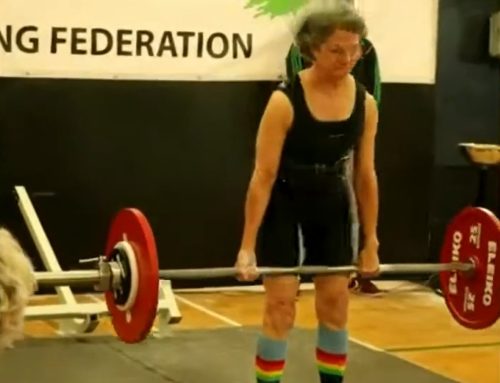
Strong at 66!
However, there are two primary approaches to this.
One focuses on pure strength training with the primary tool being the barbell. This is even recommended for people over 80, much to the horror of the majority of the fitness world, which views exercises such as squats and deadlifts as too dangerous.
As a result of this irrational fear, many of these coaches and trainers recommend training with lighter weights to build muscle.
Based upon the data discussed, however, it’s clear that the attention should actually be focused on building strength.
Another reason why it makes no sense to only train with lighter weight and higher reps is that as we age, it becomes more and more difficult to actually build skeletal muscle mass.
This means that you need to lift heavier weight, because that is what is required to build strength more efficiently.
The most common protocol involves training within a rep range of 3 to 6 reps and at a weight that is upwards of 80% of your 1 rep maximum.
For instance, if you can bench press 100 pounds, you will want to train with weight upwards of 80 pounds and do sets of 3 to 6 reps.
Once you’ve reached a strength level that meets your goals, you can then focus on maintenance.
Dr. Sullivan indicates that the older his clients are, the more dependent upon training intensity that they become.
In other words, older trainees must continue to expose themselves to training with heavy weight in order to avoid detraining.
At the same time, he notes that they become sensitive to too much training volume because their ability to recover diminishes over time.
Aerobic exercise and maintenance of muscle function
Despite being most strongly associated with improvements in cardiorespiratory fitness and insulin sensitivity, aerobic exercise has been demonstrated to preserve both muscle mass and function in older adults.
Preservation of muscle function with aerobic exercise has been suggested to be due to increased oxidative capacity and improved mitochondrial efficiency.
Nutritional strategies
 It’s been written about extensively that increased protein intake is necessary as we age to maintain muscle mass and strength.
This is due to our declining ability to synthesize protein into muscle as we age.
Omega-3 fatty acids are also found to be useful in the maintenance of skeletal muscle mass among older adults.
While typically recommended for their cardiovascular health benefits, Omega-3 fatty acids have also been demonstrated to be helpful in building and maintaining skeletal muscle mass in older adults.
Additional nutraceutical compounds such as Creatine and Vitamin D have also shown potential to help in building muscle and strength.
Increased overall activity

Active couple
Outside of your training for strength and improved cardiovascular health, you should remain active in your daily life.
Hobbies such as walking, hiking, tennis, swimming, martial arts, etc., that keep you moving and active will also assist with neuromuscular function.
Martial arts in particular have demonstrated positive benefits on cognitive function and motor skill development and maintenance.
Final Thoughts
Improved strength and skeletal muscle mass have clearly been demonstrated to have a significantly positive benefit on quality of life as we age.
However, if you are not active in building and maintaining strength, it will decline rapidly, particularly after you’ve entered your eighth decade of living.
Even if you continue to remain reasonably active, and you exercise, if you do not continue to expose yourself to lifting heavy weight, your overall strength will still diminish quickly.
A proper strength training program combined with good nutrition, cardio exercise and increased overall activity will go a long way toward ensuring a high quality of living if you live to an advanced age.




Leave A Comment